
By Sunhorizon Potentiometer Editorial Team | July 27, 2026
Table of Contents
- Understanding Rotary Control Components and Key Parameters
- Full Range Technical Parameter Comparison
- How Engineers Select the Right Rotary Control Solution
- Carbon Track Technology and Performance Differences
- Factory Direct Manufacturing Advantages
- Future Trends in Rotary Control Components
- Sources
Understanding Rotary Control Components and Key Parameters
Rotary control components remain essential in audio equipment, industrial instruments, automation systems, and consumer electronics. Engineers selecting a suitable solution must evaluate electrical specifications, mechanical structure, operating environment, and lifetime requirements.
A professional potentiometer works as an adjustable resistance device that converts rotational movement into electrical signal changes. Depending on the application, manufacturers offer different structures including single-turn models, multi-turn designs, dual-gang versions, and sealed solutions.
For OEM buyers, choosing the correct rotary control component requires understanding parameters such as:
- Resistance value
- Rated power
- Rotation angle
- Shaft type
- Mounting method
- Operating torque
- Electrical lifespan
Different applications require different designs. For example, audio equipment usually focuses on smooth rotation and low noise, while industrial equipment requires higher durability and accuracy.
Full Range Technical Parameter Comparison of Rotary Control Solutions
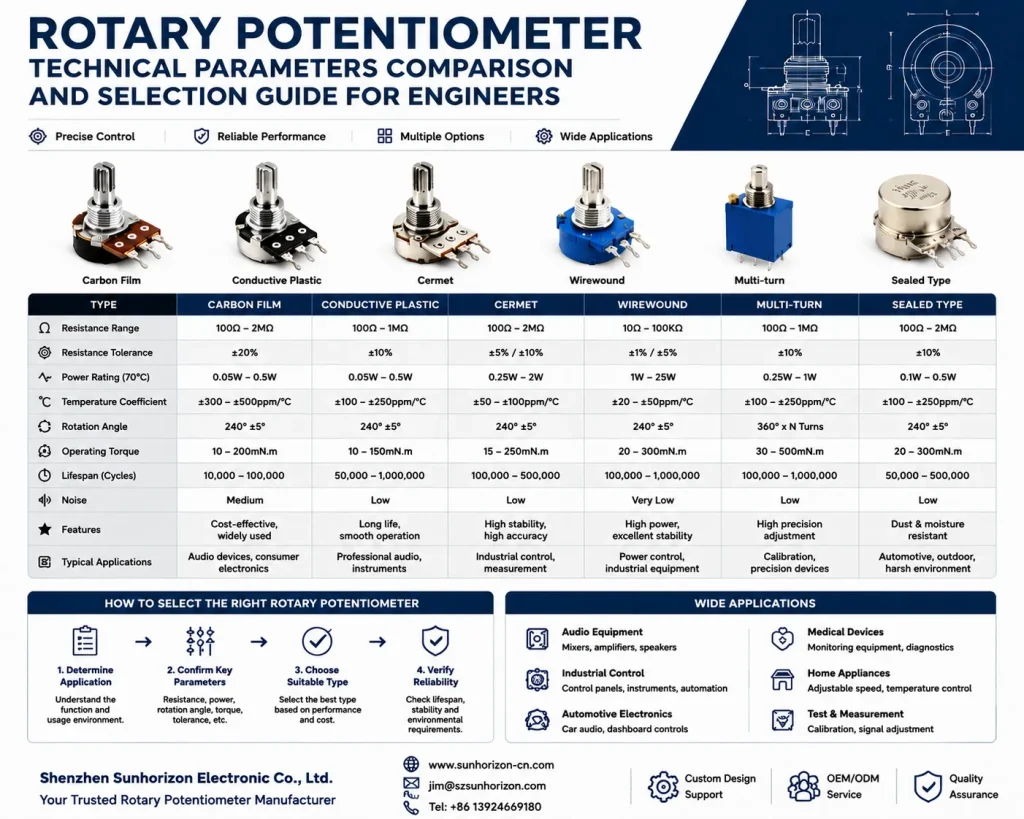
Different rotary resistor designs provide different performance characteristics. The following table helps engineers compare common options.
| Product Type | Typical Resistance Range | Main Feature | Common Applications |
|---|---|---|---|
| Carbon Track Rotary Model | 1KΩ-2MΩ | Cost-effective, smooth adjustment | Audio equipment, consumer electronics |
| Conductive Plastic Model | 1KΩ-1MΩ | Long lifespan, low noise | Professional audio, medical devices |
| Multi-Turn Adjustable Resistor | 100Ω-1MΩ | High adjustment accuracy | Industrial control, measurement equipment |
| Dual Gang Rotary Model | 5KΩ-500KΩ | Synchronized channel control | Amplifiers, mixers, HIFI systems |
| Sealed Rotary Control | 1KΩ-1MΩ | Dust and moisture resistance | Automotive electronics, outdoor equipment |
When selecting a suitable model, engineers should consider both electrical performance and mechanical requirements.
A standard variable resistor may satisfy basic adjustment needs, while advanced systems often require customized solutions with specific torque, shaft dimensions, and mounting structures.
How Engineers Select the Right Rotary Control Solution
Choosing the correct component involves more than selecting resistance values. Professional engineers normally evaluate several technical factors.
1. Resistance Value
Resistance determines the adjustment range. Common values include:
- 1KΩ
- 5KΩ
- 10KΩ
- 50KΩ
- 100KΩ
- 500KΩ
Audio applications frequently use logarithmic characteristics because human hearing responds differently to volume changes.
2. Mechanical Structure
The shaft design affects installation compatibility.
Common options include:
- Metal shaft
- Plastic shaft
- Knurled shaft
- Flat shaft
- Threaded shaft
Different equipment designs require different mechanical interfaces.
3. Rotation Torque
Torque directly affects user experience.
Audio equipment requires smooth operation, while industrial devices may require stronger mechanical feedback.
A well-designed rotary control component provides stable torque throughout its service life.
4. Environmental Requirements
Industrial and automotive applications often require:
- Temperature resistance
- Vibration resistance
- Dust protection
- Long cycle life
Sealed designs help improve reliability in demanding environments.
Carbon Track Technology and Performance Differences
Carbon-track control remains one of the most widely used technologies because it offers a balance between performance and cost.
A carbon film structure provides:
- Stable electrical output
- Smooth adjustment
- Good production consistency
- Competitive pricing
However, high-end applications increasingly adopt conductive plastic technology.
Compared with traditional carbon designs, conductive plastic solutions provide:
| Feature | Carbon Track | Conductive Plastic |
|---|---|---|
| Cost | Lower | Higher |
| Lifespan | Standard | Longer |
| Noise Performance | Good | Excellent |
| Precision | Medium | High |
| Application Level | General electronics | Professional equipment |
According to component industry standards, reliability testing and lifecycle evaluation remain important factors when selecting electronic control components.
The International Electrotechnical Commission (IEC) provides international standards covering electronic components and reliability evaluation methods.
Factory Direct Manufacturing Advantages for Global Buyers
For international buyers, supplier capability has become an important purchasing factor.
A reliable rotary control manufacturer should provide:
- Engineering support
- Custom development
- Production quality control
- Stable supply capacity
- Technical documentation
Shenzhen Sunhorizon Electronic Co., Ltd. focuses on manufacturing rotary control components, slide controls, rotary switches, and encoders for global customers.
With engineering support and production experience, manufacturers can help customers optimize:
- Electrical specifications
- Mechanical dimensions
- Assembly requirements
- Application performance
Future Trends in Rotary Control Components
Although touchscreen interfaces continue growing, physical adjustment components remain valuable in many professional applications.
Future development focuses on:
Higher Precision
Industrial automation requires more accurate signal adjustment.
Longer Lifetime
Professional equipment requires millions of operating cycles.
Smart Integration
Modern systems combine mechanical controls with digital feedback functions.
Customized OEM Design
More companies prefer manufacturers capable of developing application-specific solutions.
For engineers and purchasing teams, selecting a manufacturer with technical experience can reduce development risks and improve product reliability.
Authority Reference Module
“Electronic components with higher reliability and customization capability play an important role in modern industrial and consumer applications.”
— International Electrotechnical Commission (IEC)
Sources
- International Electrotechnical Commission (IEC)
https://www.iec.ch/ - Mouser Electronics Component Resources
https://www.mouser.com/ - DigiKey Technical Resources
https://www.digikey.com/ - International Organization for Standardization (ISO)
https://www.iso.org/