
September 10, 2026
Table of Contents
- Why Factory Selection Matters for Audio Equipment
- Check Audio Taper and Resistance
- Evaluate Carbon Track and Noise
- Compare Mechanical Design and Life
- Check PCB and Custom Requirements
- Compare Different Factory Types
- Ask for Samples and Technical Data
- Conclusion
- Sources
Why Factory Selection Matters for Audio Equipment
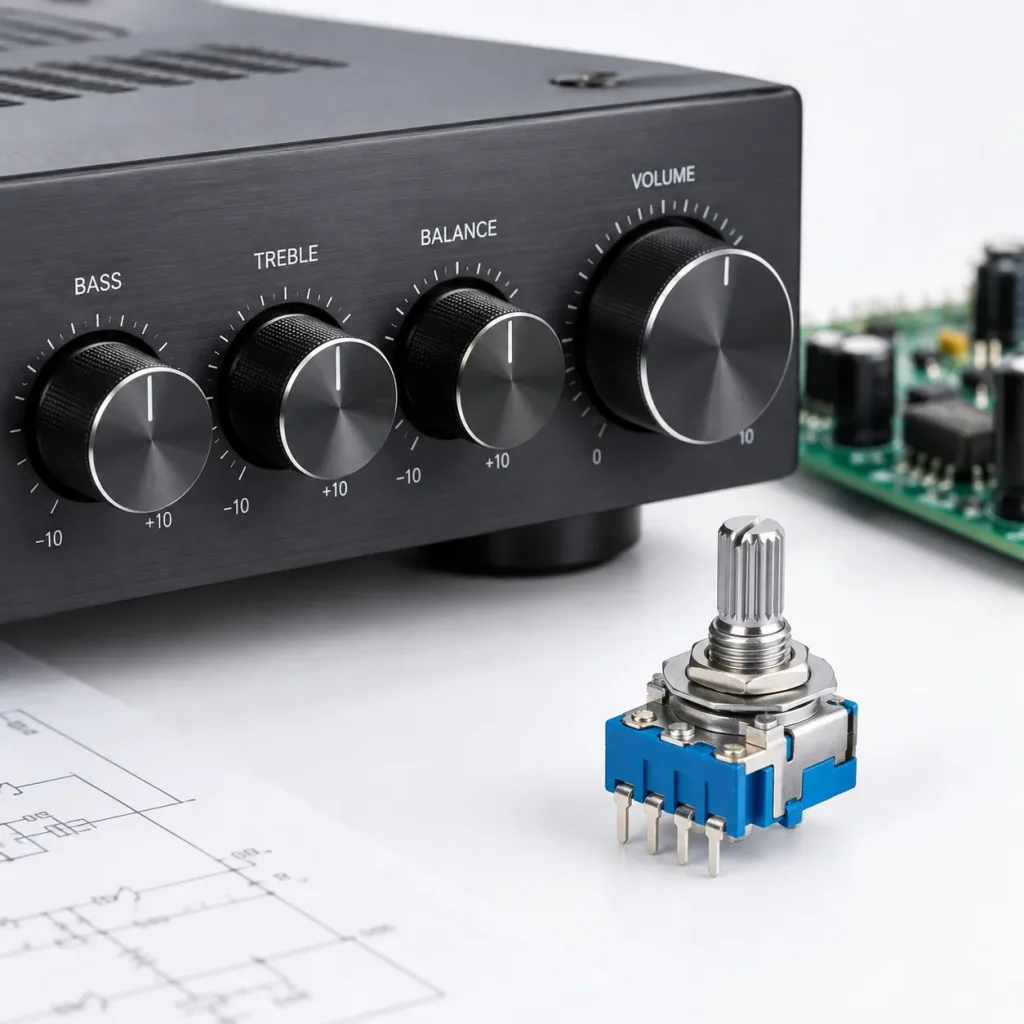
Choosing the right potentiometer factory is important for audio amplifiers, mixers, active speakers, musical instruments, and other sound equipment.
The component does more than change volume. It also affects control feel, channel balance, noise, installation, and service life.
A professional manufacturer should understand both electrical and mechanical requirements. It should also provide clear technical data before mass production.
For buyers, the first question should not be “Who offers the lowest price?” A better question is “Can this factory make the same specification with stable quality?”
Alps Alpine notes that its variable resistor products have a strong history in audio and professional audio applications. Its product range includes rotary and slide types for different control needs.
For a factory buyer, this means application experience matters.
Check Audio Taper and Resistance
Resistance value is one of the first specifications to check.
Common audio values include 10KΩ, 20KΩ, 50KΩ, 100KΩ, and 250KΩ. The correct value depends on the circuit design.
The resistance taper is just as important.
A linear adjustable resistor changes resistance at a roughly even rate. An audio-taper design uses a different curve. This can provide a more natural volume change for human hearing.
Alps Alpine explains that resistance taper is important for level adjustment. Its technical guide also distinguishes between curves used for different control characteristics.
When asking a factory for a quote, provide:
- Total resistance
- Resistance taper
- Single or dual gang
- Rated power
- Rotation angle
- Shaft length
- Shaft shape
- Mounting method
- Terminal layout
Do not select a replacement only by resistance value.
Evaluate Carbon Track and Noise
For many audio controls, the resistive element is a key quality factor.
A carbon-track control can provide a practical balance between cost and performance. But material alone does not guarantee low noise.
Wiper contact, carbon track quality, assembly accuracy, and production control can all affect performance.
Bourns lists carbon, cermet, and conductive plastic among the element options used in its panel-control products. Its products serve applications such as audio mixing consoles and consumer electronics.
Sliding noise is another useful specification.
A noisy control can produce unwanted crackling when the shaft moves. For audio equipment, buyers should ask the supplier for noise data and test conditions.
For example, the Bourns PTD90 series specifies a maximum noise level of 100 mV and tracking error within ±3 dB. It also offers audio taper and carbon elements.
This type of data is more useful than simply asking whether a product is “high quality.”
Compare Mechanical Design and Life
Audio equipment often uses its volume control many times a day.
The shaft must therefore provide stable movement and suitable torque. The bushing, shaft material, mounting structure, and internal contact system also matter.
Metal shafts can offer strong mechanical support. Plastic shafts can reduce weight and cost. The better choice depends on the product design.
For compact audio equipment, size can also become a major issue. A 9 mm or 11 mm rotary resistor may fit where a larger control cannot.
Alps Alpine provides several rotary control sizes and configurations for audio applications. Its RK271 series, for example, is designed for audio use and includes dual-unit options.
Mechanical life should also match the expected use.
Do not compare factories only by a life number. Check the test method, operating conditions, torque, and actual production model.
Check PCB and Custom Requirements
A common purchasing mistake is to choose a component that looks similar but does not fit the PCB.
The factory should be able to check:
- PCB pin spacing
- Mounting holes
- Bushing size
- Shaft diameter
- Shaft length
- Shaft shape
- Overall body size
- Panel clearance
This is especially important when replacing an existing audio control.
A good manufacturer should be able to review a PCB drawing, sample, or competitor part number.
For example, Sunhorizon provides customization for resistance, shaft type, dimensions, terminal structure, and packaging.
Buyers can also review the company’s rotary control technical guide for a broader parameter comparison.
Compare Different Factory Types
Not every supplier has the same production capability.
| Supplier type | Main advantage | Possible limitation | Best for |
|---|---|---|---|
| Trading company | Easy sourcing | Limited production control | Standard parts |
| Large global brand | Strong documentation | Higher cost in some cases | High-volume projects |
| Specialist factory | Flexible production | Requires supplier audit | OEM/ODM projects |
| Small workshop | Low initial cost | Quality may vary | Simple prototypes |
For audio equipment, a specialist factory can be useful when the project needs custom shaft dimensions, special tapers, dual-gang structures, or PCB changes.
However, buyers should verify the actual manufacturing capability.
Ask whether the supplier controls production in-house. Check its quality process, sample consistency, test records, and ability to support mass production.
Ask for Samples and Technical Data
Before placing a large order, request samples.
The sample should match the proposed production specification.
Test the following points:
- Resistance value
- Resistance taper
- Rotation torque
- Channel tracking
- Contact noise
- Shaft fit
- PCB fit
- Switch function, if included
- Mechanical operation
- Long-term reliability requirements
A technical datasheet should support the main specifications.
Global manufacturers use detailed product data for this reason. For example, Bourns provides electrical, mechanical, and environmental specifications for its audio-related controls.
The same principle applies when selecting a China-based manufacturer. A factory should be able to explain its specifications clearly rather than relying only on product photos.
Authority Reference: What Should Buyers Check?
Alps Alpine: Its technical information identifies audio as an application for rotary controls and explains resistance taper, maximum attenuation, insertion loss, and sliding noise.
Bourns: Its panel-control portfolio covers carbon, cermet, and conductive-plastic elements and includes audio mixing consoles among typical applications.
Practical takeaway: Use manufacturer datasheets to compare electrical, mechanical, and environmental specifications. Do not judge a supplier by price alone.
Conclusion
The best potentiometer factory for audio equipment is not simply the cheapest supplier.
A better choice combines stable production, suitable materials, clear technical data, consistent samples, and flexible engineering support.
For audio projects, pay special attention to resistance, audio taper, contact noise, channel tracking, shaft design, PCB footprint, and mechanical life.
A reliable factory should also help engineers solve fit and customization issues before production.
For buyers looking for a manufacturer rather than a simple trading supplier, Sunhorizon’s product range includes rotary controls, slide controls, encoders, and rotary switches for audio and other electronic applications.
The safest purchasing method is simple: define the specification, request samples, check the technical data, test the sample, and then evaluate the factory’s ability to support stable mass production.