
September 15, 2026
Table of Contents
- Rotary or Slide: What Is the Difference?
- Rotary Potentiometer: When Should You Choose It?
- Slide Potentiometer: When Is It Better?
- Technical Comparison
- How to Choose for Audio Applications
- How to Choose for Industrial Applications
- OEM and Custom Selection
- Conclusion
- Sources
Rotary or Slide: What Is the Difference?
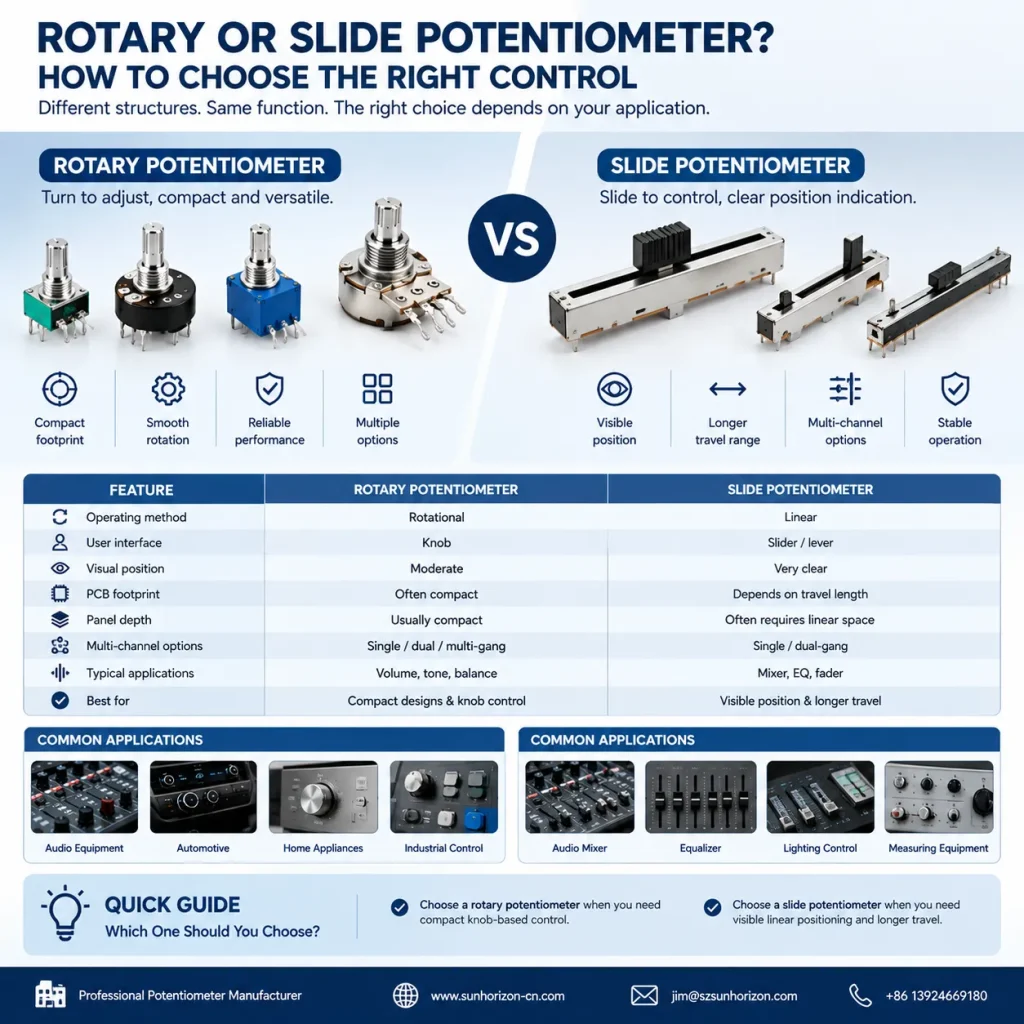
Both rotary and slide controls perform the same basic electrical function: they adjust resistance and provide variable control within an electronic circuit. The main difference is how the user operates the component.
A rotary design uses a shaft that turns through a defined angle. A slide design uses a lever that moves along a linear travel path.
The right choice depends on the equipment structure, available space, user interface, control range, and application requirements.
For example, rotary controls work well with compact front panels and traditional knobs. Slide controls provide a clear visual position and are particularly useful when users need to adjust several channels simultaneously.
Sunhorizon manufactures both rotary and slide solutions for audio, industrial control, consumer electronics and other OEM applications.
Rotary Potentiometer: When Should You Choose It?
A rotary potentiometer is usually the better choice when the product requires compact installation and knob-based operation.
Typical applications include:
- Audio amplifiers
- Car audio
- HIFI equipment
- Home appliances
- Industrial control panels
- Medical equipment
- Consumer electronics
A compact rotary design can occupy relatively little PCB space. For example, Sunhorizon offers 9mm and 11mm rotary models for space-constrained applications.
The 9mm RD092N-HA-CC-F supports through-hole PCB mounting, metal shaft options, selectable click positions and resistance configurations according to project requirements.
For dual-channel audio, the 11mm RA111G-H combines two resistance channels in one compact component and uses horizontal PCB mounting.
Slide Potentiometer: When Is It Better?
A slide potentiometer uses a linear movement instead of rotation. This structure provides a highly visible control position, which makes it popular in professional audio equipment and control interfaces.
Typical applications include:
- Audio mixers
- Equalisers
- Amplifiers
- Lighting controls
- Industrial control panels
- Measuring equipment
- Communication equipment
For example, Sunhorizon’s SC306G-H uses a 30mm travel and dual-slider structure, making it suitable for applications that require synchronized adjustment of two signal channels.
For professional audio equipment, longer travel can provide more obvious visual feedback. Sunhorizon also offers 45mm and 60mm slide designs for different installation and control requirements.
Rotary vs Slide Potentiometer: Technical Comparison
| Feature | Rotary Design | Slide Design |
|---|---|---|
| Operating method | Rotational | Linear |
| User interface | Knob | Slider/lever |
| Visual position | Moderate | Very clear |
| PCB footprint | Often compact | Depends on travel length |
| Panel depth | Usually compact | Often requires linear space |
| Multi-channel options | Single/dual/multi-gang | Single/dual-gang |
| Audio applications | Volume, tone, balance | Mixer, EQ, fader |
| Industrial applications | Knob-based adjustment | Linear control interface |
| Compact products | Excellent | Depends on travel |
| Position feedback | Rotation angle | Direct slider position |
Neither design is universally better. The correct choice depends on the mechanical interface and user operation.
Choosing Between Rotary and Slide Controls for Audio
Audio equipment provides one of the clearest examples of where the two designs differ.
Choose a Rotary Design When:
- The product uses traditional knobs.
- PCB space is limited.
- Users need volume or tone adjustment.
- The panel has limited horizontal space.
- A compact dual-gang solution is required.
A dual-gang rotary design can control left and right audio channels simultaneously. This makes it suitable for stereo volume and balance functions.
Choose a Slide Design When:
- Users need a visible control position.
- Several channels require individual adjustment.
- The application uses fader-style controls.
- Long linear travel improves adjustment accuracy.
A 45mm or 60mm slide design can provide a larger physical adjustment range than a compact rotary control. Sunhorizon’s 60mm SD606G-H, for example, combines a 60mm travel with a dual-gang structure.
Choosing a Rotary or Slide Control for Industrial Equipment
Industrial applications require additional consideration.
Engineers should check:
- Operating life
- Operating torque or force
- Resistance tolerance
- Electrical noise
- Insulation resistance
- Mounting structure
- Environmental protection
- Available installation space
A rotary control may work better for compact machine panels, while a slide control can provide intuitive linear positioning.
For demanding applications, buyers should review the manufacturer’s datasheet rather than selecting a component based only on body size or price.
OEM Selection: Match the Component to the Product
For OEM projects, the decision does not need to stop at standard models.
Manufacturers can often customise:
- Resistance value
- Taper
- Shaft length
- Shaft shape
- Mounting structure
- Terminal configuration
- Travel length
- Operating torque
- Packaging
Sunhorizon’s website states that its OEM and ODM capabilities include custom resistance values, shaft types, sizes and terminal structures.
This approach can help engineers select a control component that matches the PCB, enclosure and user interface at the same time.
Which One Should You Choose?
The simplest rule is:
Choose rotary when you need compact knob-based control.
Choose slide when you need visible linear positioning and longer travel.
For audio equipment, both options remain important. A rotary design can suit volume and tone controls, while a slide design works well for mixers, equalisers and faders.
For industrial equipment, the decision should focus on the complete mechanical and electrical specification rather than the control style alone.
For OEM buyers, the best approach is to provide the manufacturer with the PCB drawing, installation dimensions, resistance requirements and expected operating conditions. Engineers can then determine whether a rotary or slide solution offers the better fit.