
By Sunhorizon Editorial Team | August 27, 2026
Table of Contents
- Why the Price Gap Is So Large
- Material Cost: More Than Just Resistance
- Carbon-Track Controls vs. Precision Designs
- Mechanical Life and Contact Quality
- Tolerance, Stability and Testing
- Production Volume and Supply Chain
- How Buyers Should Compare Prices
- The Real Cost Behind the Number
Why the Price Gap Is So Large
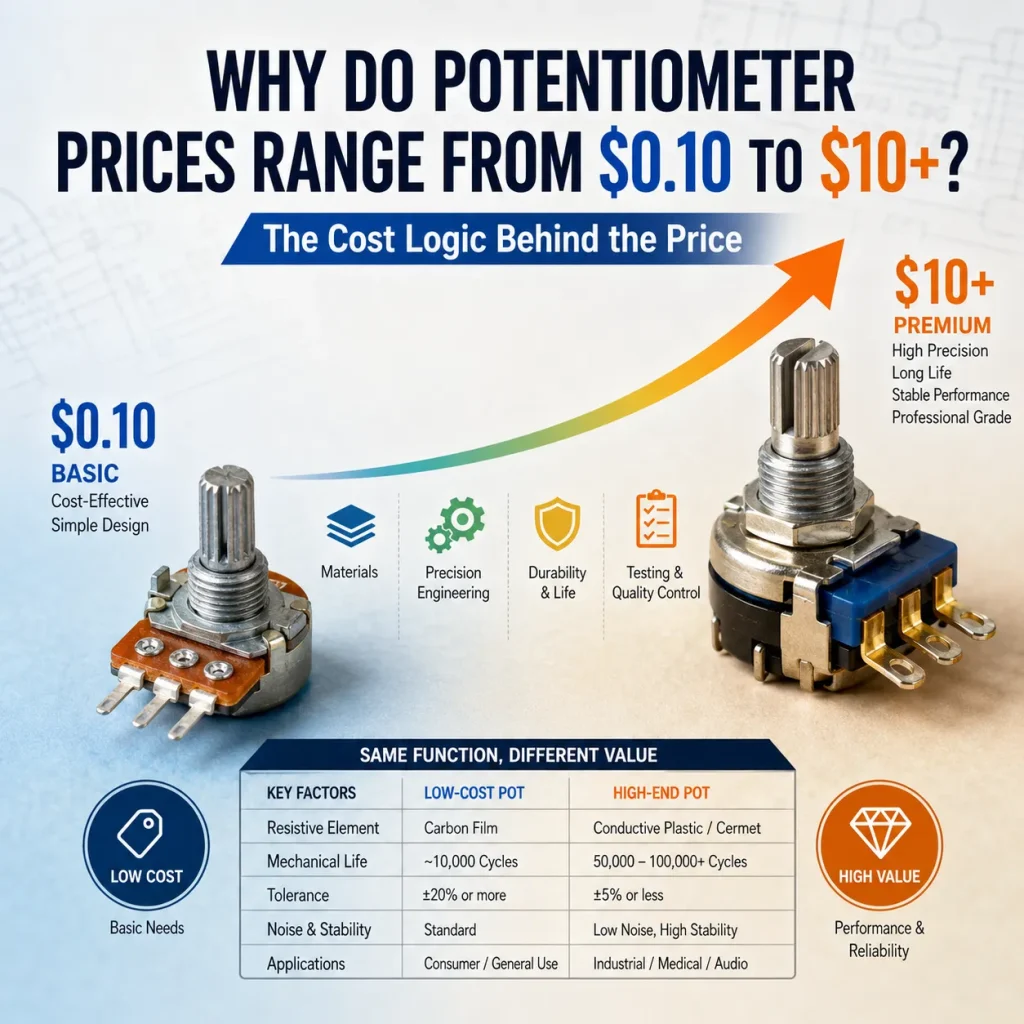
A buyer can find a basic rotary potentiometer for around $0.10 and a precision part for more than $10. Some specialized models can cost even more. At first glance, this looks like a huge price gap for a simple control.
The key point is that these parts do not provide the same performance.
A low-cost pot may use a simple carbon element, plastic housing and basic terminals. It may suit consumer products with moderate use.
A premium variable resistor may use conductive plastic, cermet or another specialized resistive material. It can also require tighter tolerance, better sealing, stronger mechanical parts, longer life and more testing.
Bourns notes that contact design can affect contact resistance, noise, power rating, operational life and stability.
So, the price is not based only on the resistance value.
Material Cost: More Than Just Resistance
The resistive element is one important cost driver.
A basic carbon-track control can use a low-cost resistive layer. More demanding applications may use conductive plastic or cermet. Vishay lists cermet and conductive plastic as key element choices for panel controls.
The housing also matters.
A low-cost body may use standard plastic. A higher-grade design can require:
- Stronger shaft materials
- Metal bushings
- Better bearings or support structures
- Sealing parts
- Special lubricants
- Better terminals
- More precise mechanical parts
Bourns explains that special lubricants can help reduce oxidation and contact noise.
This means two parts with the same 10 kΩ rating can have very different production costs.
For buyers comparing a rotary resistor product range, the full construction should be checked before comparing unit prices.
Carbon-Track Controls vs. Precision Designs
A carbon-track control is often a practical choice for general electronic equipment.
For example, Bourns’ PDB08 series uses a carbon element, plastic shaft and PC pins. It has a stated rotational life of 10,000 cycles.
A precision adjustable resistor can have a very different design target.
A conductive-plastic model may offer tighter mechanical control, better stability or a much longer service life. One Nidec Components example uses a conductive-plastic element and is described as a long-life device.
The difference becomes clearer in industrial, medical, automotive or professional audio equipment. In these products, a small change in noise, torque or repeatability can affect the user experience or system performance.
This is why buyers should compare specifications, not only appearance.
Mechanical Life and Contact Quality
The shaft is a mechanical interface. Every turn creates movement between the wiper and resistive element.
This creates friction and wear.
A low-cost adjustable resistor may be designed for limited manual adjustment. A premium unit may need tens of thousands or even 100,000 cycles.
For example, Amphenol Piher lists selected carbon models with IP54 protection and up to 100,000 mechanical life cycles, depending on the series.
Bourns also shows large differences between product families. Its PDB185-GTR series lists 15,000 cycles, while other product families target different adjustment requirements.
Contact quality matters too.
Poor contact control can increase noise and contact resistance variation. Bourns identifies the wiper as a major factor in noise, contact resistance, resolution and operational life.
Therefore, a higher price may reflect better contact materials, better spring force, tighter assembly and more controlled lubrication.
Tolerance, Stability and Testing
Resistance value is only one specification.
Engineers may also check:
- Resistance tolerance
- Contact resistance variation
- Temperature coefficient
- Power rating
- Rotation angle
- Torque
- Electrical travel
- Insulation
- Sealing
- Mechanical life
A standard part may accept a wide tolerance. A precision rotary resistor may require much tighter control.
Bourns’ 3006 multiturn series, for example, specifies a temperature coefficient of ±100 ppm/°C and defined contact resistance variation limits.
These specifications require better materials and tighter production control.
They also increase inspection costs.
A factory must control raw materials, production machines, assembly processes and final testing. More test points mean more labor, equipment and time.
Production Volume and Supply Chain
Production volume can strongly affect unit price.
A standard part made in large quantities can spread tooling, setup and inspection costs across thousands or millions of units.
A special part made in small quantities cannot do this.
Distribution also affects the final price.
For example, current distributor listings show large differences between standard and specialized products. A Nidec CRV16 example is listed at more than $12 for a single unit, with lower prices at higher quantities.
An Amphenol Piher PC-16 carbon model is listed at a lower unit price at higher order quantities, while still carrying costs for its construction, protection and specifications.
The distributor price can therefore include packaging, inventory, logistics, technical support and channel margin.
The factory price is only one part of the final cost.
How Buyers Should Compare Prices
A professional buyer should avoid asking only:
“How much is one piece?”
A better question is:
“What performance do I get for this price?”
| Cost factor | Basic low-cost part | Mid-range part | Precision or special part |
|---|---|---|---|
| Resistive element | Carbon | Improved carbon/conductive plastic | Conductive plastic, cermet or special design |
| Housing | Standard plastic | Improved structure | High-grade or sealed construction |
| Shaft | Basic plastic/metal | Metal or reinforced | Precision metal |
| Tolerance | Wider | Medium | Tight |
| Life | Moderate | Higher | Long-life design |
| Sealing | Limited | Optional | Higher protection |
| Testing | Basic | Standard QC | Extensive testing |
| Typical use | Consumer products | General equipment | Industrial, medical, professional equipment |
| Unit cost | Low | Medium | High |
The right choice depends on the application.
For a simple consumer control, paying for features that the product does not need may waste money.
For industrial equipment, the cheapest part can become expensive if early failure causes service work or warranty claims.
Buyers can also review a manufacturer’s potentiometer selection guide before requesting samples or quotations.
The Real Cost Behind the Number
The difference between $0.10 and $10 is rarely caused by one single item.
It usually comes from a combination of:
Material + mechanical design + precision + testing + reliability + production volume + distribution.
A basic pot is designed to perform a basic task at low cost.
A premium variable resistor is designed to deliver controlled performance over a defined operating life and environment.
That is why two products that look almost identical can have very different prices.
For OEM and industrial buyers, the better approach is to define the required specifications first. Then compare suppliers on the same technical basis.
A low quotation is useful only when the part meets the required life, tolerance, noise, torque, sealing and reliability targets.
In other words, the cheapest rotary potentiometer is not always the lowest-cost solution. The real cost is determined by how well the component performs throughout the product’s service life.
Authority Reference
Bourns: Wiper and contact design can influence contact resistance, noise, power rating, operational life and stability.
Vishay: Panel-control selection can depend on resistive element material, dimensions and sealing requirements.
Amphenol Piher: Selected carbon models combine IP54 protection with configurations offering up to 100,000 mechanical life cycles.