
By Sunhorizon Editorial Team | September 1, 2026
Table of Contents
- Are Small-Size Rotary Potentiometers Available?
- Common Compact Sizes and Designs
- 9mm Rotary Potentiometer for Space-Limited Applications
- 11mm Rotary Potentiometer for Dual-Channel Control
- How to Select a Small Rotary Control
- Compact Design vs Standard Size
- OEM Customization for Small Components
- Conclusion
Are Small-Size Rotary Potentiometers Available?
Yes. Small-size rotary potentiometers are widely used when PCB space, installation height, or panel dimensions are limited.
As electronic products become smaller, engineers need control components that occupy less board space without sacrificing basic electrical and mechanical performance. Compact audio equipment, automotive electronics, home appliances, industrial control panels, and portable devices can all benefit from miniature rotary controls.
The key point is that smaller does not simply mean shorter. Engineers need to consider the body diameter, shaft length, mounting direction, terminal arrangement, rotational torque, resistance value, and installation height together.
Sunhorizon currently offers compact rotary models including 9mm and 11mm designs, giving OEM buyers options for space-constrained applications.
Common Compact Sizes and Designs
There is no single standard definition of a “small” rotary control. Manufacturers can reduce the overall footprint in several ways.
| Design | Typical Advantage | Suitable Applications |
|---|---|---|
| 9mm class | Very compact body | Portable electronics, PCB controls |
| 11mm class | Compact with more configuration options | Audio, automotive, industrial controls |
| Horizontal mount | Reduces PCB height | Low-profile equipment |
| Dual-gang design | Two channels in one component | Stereo audio |
| Sealed structure | Better protection from contaminants | Automotive and industrial equipment |
| Short shaft | Reduces panel depth | Compact control panels |
Engineers should therefore select the complete mechanical structure rather than choosing a component based only on body diameter.
9mm Rotary Potentiometer for Space-Limited Applications
A 9mm model can provide a practical solution when PCB space is particularly limited.
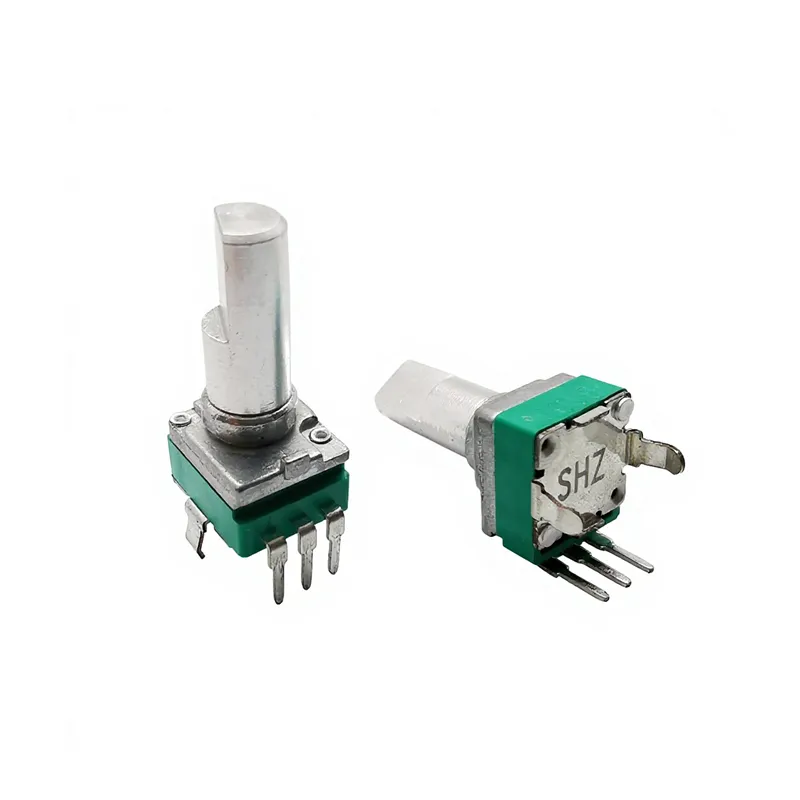
For example, the RD092N-HA-CC-F from Sunhorizon uses a compact 9mm structure, metal shaft, insulated body, and through-hole PCB terminals. The manufacturer specifies a total rotational angle of 280° ±10° or 300° ±10°, depending on configuration.
The model supports resistance configurations from 1KΩ to 1MΩ, depending on specification, and offers optional centre-click or 21-click positioning. Its rotational life is specified at ≥10,000 cycles.
This type of compact variable resistor can suit:
- Audio volume adjustment
- Signal control
- Brightness adjustment
- Speed control
- Smart control panels
- Consumer electronics
- Automotive electronics
For engineers working with limited PCB space, the 9mm class can reduce the component footprint while retaining a familiar rotary operating method.
11mm Rotary Potentiometer for Dual-Channel Control
An 11mm design provides another option for compact electronic products.
Sunhorizon’s RA111G-H is an 11mm sealed dual-unit rotary model with horizontal PCB mounting and an insulated plastic shaft. Its dual-gang construction combines two independent resistance channels in one component.
This structure is particularly useful for stereo audio applications. One shaft can control two channels simultaneously, helping reduce component count and PCB space.
The RA111G-H supports resistance values from 1KΩ to 1MΩ, depending on configuration. Its total rotational angle is 300° ±10°, while the specified rotational life is ≥10,000 cycles.
Typical applications include:
- Stereo volume control
- Audio amplifiers
- Mixing equipment
- Car audio
- Industrial control panels
- Compact electronic equipment
How to Select a Small Rotary Control
Choosing a miniature adjustable resistor requires more than checking its diameter.
1. Check the Installation Space
Measure:
- PCB footprint
- Component height
- Panel thickness
- Shaft clearance
- Distance between neighbouring components
A 9mm body may save PCB space, but the shaft and mounting hardware can still affect the final assembly.
2. Select the Resistance Value
Common values include 1KΩ, 5KΩ, 10KΩ, 50KΩ, 100KΩ and 500KΩ.
The correct value depends on the circuit design rather than the physical size of the component.
3. Consider the Mounting Direction
Horizontal mounting can be useful when PCB height is limited. The RA111G-H, for example, uses a horizontal PCB mounting structure.
4. Check Shaft Requirements
Shaft type and length affect knob compatibility and panel installation.
Possible options include:
- Flat shaft
- Knurled shaft
- Plastic shaft
- Metal shaft
- Custom shaft length
5. Consider Operating Feel
Rotational torque affects how the control feels during operation. For audio products, smooth and consistent rotation can be especially important.
Compact Design vs Standard Size
A smaller component does not automatically provide better performance. Engineers should select the size according to the complete product design.
| Factor | Compact Rotary Control | Standard-Size Design |
|---|---|---|
| PCB Space | Lower requirement | Higher requirement |
| Product Miniaturisation | Excellent | Moderate |
| Shaft Options | Configuration dependent | Usually broader |
| Installation Space | Limited | More flexible |
| Dual-Gang Integration | Available in selected models | Widely available |
| OEM Customisation | Available | Available |
For compact products, the main benefit comes from integrating the right mechanical structure with the electrical specifications.
OEM Customization for Small Components
Miniature components often require more engineering attention because installation tolerances become more important as available space decreases.
Sunhorizon states that its OEM and ODM services can support customization of resistance values, shaft specifications, dimensions, terminals, and packaging.
For a new project, buyers can provide:
- PCB drawings
- Existing samples
- Mechanical drawings
- Electrical specifications
- Competitor part numbers
The manufacturer can then evaluate whether an existing compact model fits the application or whether a customized design makes more sense.
Conclusion
Small-size rotary potentiometers are available and can provide an effective solution for compact electronic products.
The 9mm class is suitable when PCB space is especially limited, while an 11mm dual-gang design can combine two control channels within a compact structure. Sunhorizon’s current product range demonstrates both approaches.
When selecting a compact rotary control, engineers should evaluate the complete specification: body size, mounting direction, resistance value, shaft structure, torque, electrical performance, and operating life.
For OEM projects, working directly with a manufacturer can also make it easier to adjust the mechanical and electrical specifications to match the final product.
Authority Reference
For electronic component selection, engineers should always verify the manufacturer’s current datasheet and project-specific specifications before mass production.
Sunhorizon provides product specifications and OEM customization information for its compact rotary control range.