
October 10, 2026
When searching for potentiometers on Google or Reddit, you may frequently encounter discussions about Hall effect sensors, magnetic position sensing, and contactless rotary controls.
Why are these technologies mentioned together? Are Hall effect sensors replacing traditional potentiometers? Can a Hall sensor perform the same function as a potentiometer?
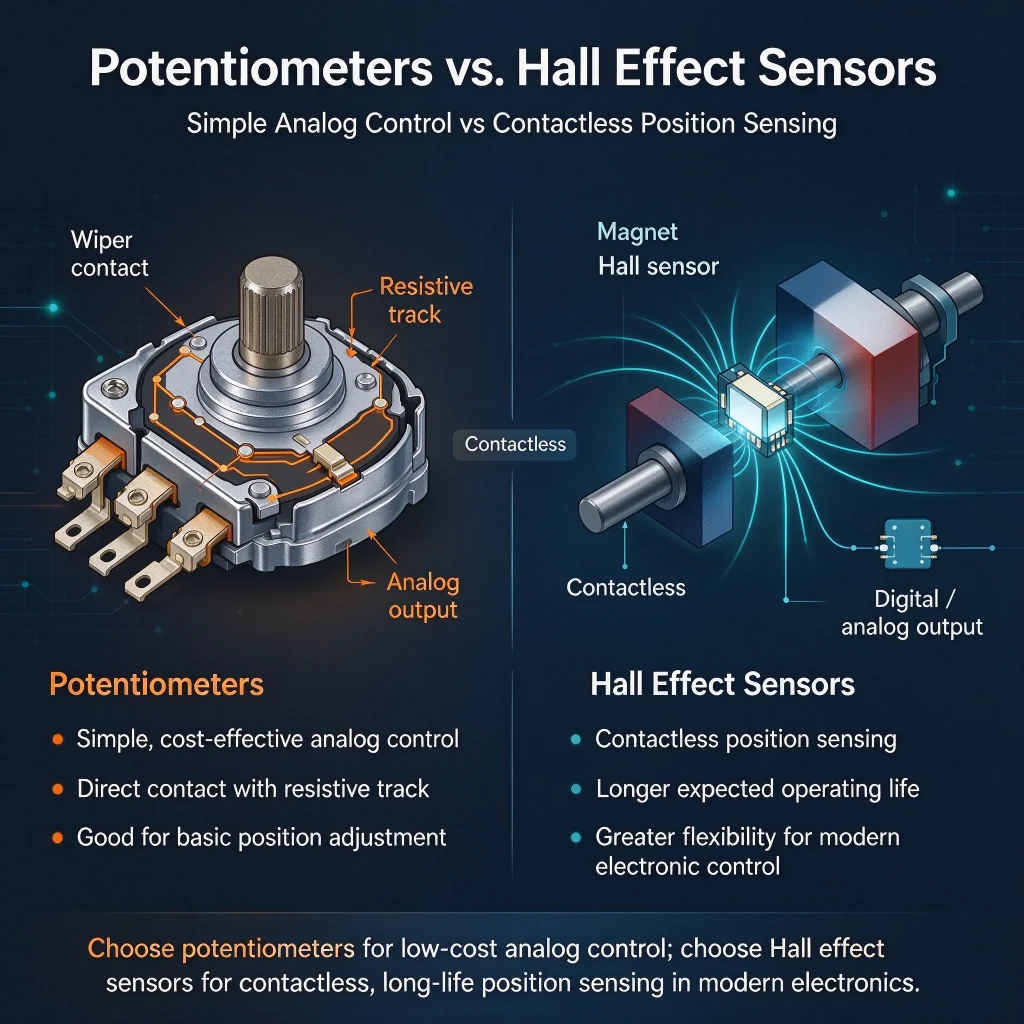
The answer is that both technologies can measure position and provide control signals, but they work in different ways. A traditional potentiometer uses a moving electrical contact, while a Hall effect sensor detects changes in a magnetic field without requiring electrical contact between the sensing elements.
Understanding these differences helps engineers select the right component for audio equipment, industrial controls, automotive electronics, and other applications.
Table of Contents
- What Is a Potentiometer?
- What Is the Hall Effect?
- Why Are Potentiometers and Hall Sensors Discussed Together?
- Potentiometer vs Hall Effect Sensor
- Can a Hall Sensor Replace a Potentiometer?
- Where Are Hall Effect Sensors Used?
- When Should You Choose a Potentiometer?
- The Future of Position Control
- Conclusion
1. What Is a Potentiometer?
A potentiometer is an adjustable electrical component that uses a resistive element and a moving contact called a wiper.
When the shaft or slider moves, the wiper changes position along the resistive track. This changes the resistance between the wiper and the terminals.
With a suitable voltage applied across the resistive element, the potentiometer can also provide a variable output voltage.
For example, a rotary potentiometer can control audio volume by changing the signal level delivered to the next stage of an audio circuit.
Common applications include:
- Audio volume and tone controls
- Amplifiers and powered speakers
- Industrial equipment adjustment
- Lighting controls
- Automotive electronic controls
- Position feedback systems
Potentiometers are available in rotary, slide, single-turn, multiturn, and other configurations. Engineers can select different resistance values, tapers, shaft dimensions, and mounting structures to suit their designs.
Manufacturers such as Bourns potentiometer product range offer resistive controls for commercial, industrial, and professional audio applications. 博恩斯
How Does a Potentiometer Work?
A typical three-terminal potentiometer has two end terminals connected to the resistive element and a third terminal connected to the wiper.
As the shaft rotates, the wiper moves along the track and changes the electrical relationship between the terminals.
This simple operating principle makes potentiometers useful for both user controls and position measurement.
However, the wiper physically contacts the resistive element. Over time, wear, contamination, or deterioration of the contact can affect performance. The actual service life depends on the component design, materials, operating conditions, and usage.
2. What Is the Hall Effect?
The Hall effect is a physical phenomenon in which a voltage develops across a current-carrying conductor or semiconductor when a magnetic field is applied in the appropriate direction.
A Hall effect sensor uses this phenomenon to detect magnetic fields.
In rotary position sensing, a magnet is usually attached to a moving shaft or mechanism, while the sensor is mounted nearby.
As the shaft rotates, the magnetic field detected by the sensor changes. The sensor’s electronics convert this information into an electrical output related to the magnetic field or position.
Unlike a traditional potentiometer, the sensing mechanism does not require a wiper to slide across a resistive track.
Hall effect position sensors are therefore useful in applications requiring frequent movement, contactless sensing, or improved resistance to wear at the sensing interface. 全球规格
How Does a Hall Effect Position Sensor Work?
A typical system includes three main elements:
- A moving shaft or mechanical component.
- A magnet attached to the moving component.
- A Hall sensor that detects the magnetic field.
The sensor processes changes in the magnetic field and generates an output.
Depending on the device, the output may be:
- An analog voltage
- A digital switching signal
- A PWM signal
- A digital data stream using an interface such as SPI or I²C
Not every Hall sensor measures continuous position. Some devices only detect whether a magnetic field has crossed a particular threshold. Engineers must select a sensor designed for the required measurement.
For rotary position control, dedicated magnetic position sensors are more appropriate than simple magnetic presence detectors.
3. Why Are Potentiometers and Hall Sensors Discussed Together?
The two technologies frequently appear in the same discussions because they can perform similar jobs.
For example, both can detect the position of a rotating shaft and provide information that a controller uses to adjust an output.
Consider a joystick.
A traditional joystick may use potentiometers to measure the movement of its axes. A Hall-based joystick uses magnets and magnetic sensors to detect the same movement without a sliding electrical contact at the sensing element.
The user moves the joystick in the same way, but the internal sensing technology differs.
The same principle applies to:
- Gaming controllers
- Throttle position controls
- Foot pedals
- Rotary adjustment knobs
- Industrial position feedback
- Automotive control systems
In online engineering discussions, users often compare these technologies when a potentiometer develops noisy readings, shows signs of wear, or needs frequent maintenance.
For example, discussions in the Reddit community r/simracing have covered replacing potentiometer-based pedal sensors with Hall effect alternatives to reduce contact-related wear. These experiences illustrate one reason engineers consider contactless sensing, although actual results depend on the design and installation. Reddit
4. Potentiometer vs Hall Effect Sensor
Although both technologies can measure position, their operating principles and system requirements differ.
| Feature | Potentiometer | Hall Effect Position Sensor |
|---|---|---|
| Operating principle | Resistive track and moving wiper | Magnetic field detection |
| Sensing contact | Electrical contact required | Contactless sensing |
| Wear at sensing interface | Possible | No sliding electrical contact |
| Typical output | Variable resistance or voltage-divider output | Analog voltage, PWM, or digital output, depending on model |
| Mechanical structure | Resistive element and wiper | Sensor and magnetic target, often with associated electronics |
| Circuit complexity | Often relatively simple | May require sensor electronics and signal processing |
| Position calibration | Depends on application | May require magnetic and electronic calibration |
| Environmental considerations | Track contamination and contact wear may matter | Magnet placement, magnetic interference, temperature, and sensor limits may matter |
| Typical applications | Volume controls, adjustments, position feedback | Joysticks, throttles, contactless rotary controls, position sensing |
Advantages of Potentiometers
1. Simple circuit integration
A conventional potentiometer can operate as a voltage divider with a suitable supply and input circuit. It often connects directly to an analog input.
2. Cost-effective design
For many applications, especially those with moderate operating frequency and straightforward requirements, a potentiometer can provide a practical balance of cost and performance.
3. Familiar mechanical design
Rotary and slide potentiometers are available in many configurations, making it easier to match an existing panel, knob, or PCB.
4. Flexible resistance characteristics
Engineers can select resistance values, tapers, shaft dimensions, and other mechanical or electrical parameters according to the application.
Advantages of Hall Effect Sensors
1. Contactless sensing
The sensing element does not need to maintain electrical contact with a moving resistive track.
2. Reduced contact-related wear
Because the position signal is detected magnetically, the sensing interface avoids the sliding electrical contact used by a conventional potentiometer.
Other mechanical parts, bearings, shafts, and linkages may still wear.
3. Suitability for frequent movement
Hall-based position sensors can be useful in applications involving repeated movement, provided the sensor, magnet, and mechanical assembly are designed for the required operating conditions.
4. Flexible electronic integration
Some Hall sensors provide analog outputs, while others support digital interfaces or programmable output characteristics. The appropriate choice depends on the controller and system architecture.
Hall technology does not automatically guarantee higher accuracy. Accuracy, linearity, resolution, repeatability, temperature drift, and long-term stability must all be checked in the datasheet.
5. Can a Hall Sensor Replace a Potentiometer?
Yes, in some applications. However, a Hall sensor is not automatically a plug-and-play replacement for a potentiometer.
This is one of the most important points for engineers and product developers.
A potentiometer and a Hall sensor may perform the same overall function, but their electrical outputs can be completely different.
Check the Output Signal
A conventional potentiometer used as a voltage divider typically provides an analog voltage determined by its wiper position and the circuit’s supply voltage.
A Hall sensor may provide an analog voltage, PWM, or digital data.
If the original circuit expects a variable analog voltage, a Hall sensor with a compatible analog output may be suitable. Even then, the output range, reference voltage, signal direction, and loading conditions must match the receiving circuit.
If the sensor provides SPI, I²C, or another digital output, the controller generally needs suitable hardware and software to read and interpret the signal.
Check the Mechanical Structure
A potentiometer typically has a shaft or slider mechanically connected to a wiper.
A Hall-based replacement may need a magnet attached to the moving part and a sensor positioned at a suitable distance and orientation.
The magnet’s movement must create a predictable magnetic field across the required operating range.
Check Calibration and Signal Processing
A Hall sensor’s output may not change linearly with mechanical position without appropriate sensor design or signal processing.
The system may require calibration, filtering, linearization, or software changes.
Check Power Requirements
A conventional potentiometer does not normally require a dedicated power supply to operate as a passive resistive component.
An active Hall sensor generally requires electrical power.
This difference can affect the circuit design, power consumption, wiring, and controller requirements.
Before replacing a potentiometer with a Hall sensor, engineers should verify the electrical interface, mechanical dimensions, output characteristics, power requirements, and controller compatibility.
6. Where Are Hall Effect Sensors Used?
Hall effect sensors are widely used in applications where magnetic field detection can provide useful position or movement information.
Gaming Controllers and Joysticks
Hall-based joysticks can measure stick movement without relying on a sliding electrical contact.
They are often considered when designers want to reduce contact-related wear. However, the overall performance still depends on the sensor, mechanics, calibration, and signal processing.
Throttle and Pedal Position Sensing
Throttle controls and pedal assemblies can use magnetic position sensors to detect mechanical movement.
The contactless sensing arrangement can be beneficial in frequently operated equipment.
Safety-critical applications require appropriate system-level validation and fault handling.
Automotive Electronics
Magnetic position sensors can be used in various automotive control and measurement systems.
Engineers must consider temperature, vibration, electromagnetic compatibility, environmental protection, and applicable safety requirements.
Industrial Equipment
Hall-based sensors can measure rotary or linear movement in machinery, actuators, and other automated systems.
The choice depends on the required measurement range, accuracy, environmental conditions, and interface with the controller.
Audio and Consumer Electronics
Magnetic sensing can also be used in electronic controls, including some rotary position interfaces.
However, conventional potentiometers remain useful for audio volume, tone adjustment, and other controls where direct analog adjustment, cost, and mechanical compatibility are important.
For audio applications, the choice should be based on the circuit requirements and the desired user experience rather than assuming that contactless sensing is always superior.
7. When Should You Choose a Potentiometer?
Hall effect sensors offer important advantages, but traditional potentiometers remain practical for many applications.
A potentiometer may be the better choice when:
- The circuit already expects a variable resistance or voltage-divider output.
- The application requires a simple, cost-effective control.
- The mechanical design already uses a standard rotary or slide component.
- The required operating life is achievable with a suitable potentiometer.
- The project has strict size, cost, or mounting constraints.
- No additional sensor electronics or software are desired.
For example, a stereo amplifier may use a dual-gang rotary potentiometer to adjust the left and right audio channels simultaneously.
A slide potentiometer may be appropriate for an audio mixer because its slider provides visible position feedback.
A Hall sensor could provide position information in a redesigned system, but the engineer would need to account for the output interface, magnetic assembly, and control electronics.
The key question is not simply which technology is newer. It is which technology best meets the requirements of the complete product.
8. The Future of Position Control
Position sensing continues to evolve as electronic equipment becomes more integrated and control systems become more sophisticated.
Traditional potentiometers remain relevant because of their familiar operation, straightforward integration, and broad range of mechanical configurations.
At the same time, contactless technologies—including Hall effect and tunnelling magnetoresistance (TMR) sensors—provide alternatives for applications with demanding operating-life or sensing requirements.
TMR sensors detect changes in magnetic resistance rather than relying on the Hall effect. Like Hall-based devices, they can be used in magnetic position-sensing systems, but their operating principles and product characteristics differ.
The choice among potentiometers, Hall sensors, and TMR sensors depends on factors such as:
- Required accuracy and resolution
- Mechanical operating life
- Environmental conditions
- Electrical interface
- Power consumption
- System cost
- Calibration requirements
- Mechanical integration
Manufacturers such as Bourns rotary position sensors offer contactless magnetic sensing products alongside traditional resistive controls, illustrating how different sensing technologies can serve different applications. 博恩斯
For engineers, the most effective approach is to define the actual system requirements first and then compare suitable technologies.
9. Conclusion
Potentiometers and Hall effect sensors are often discussed together because both can measure position and support electronic control. However, they use different sensing principles.
A potentiometer changes resistance through a moving wiper, while a Hall effect sensor detects magnetic fields without requiring a sliding electrical contact.
Hall-based position sensing can reduce contact-related wear and suit applications involving frequent movement. Traditional potentiometers remain attractive for simple, cost-effective controls and circuits that require a familiar analog interface.
When evaluating a replacement, engineers should compare output signals, power requirements, mechanical dimensions, calibration, accuracy, operating life, and total system cost.
The best choice is not always the newest technology. It is the component that meets the electrical, mechanical, and environmental requirements of the application.