
September 29, 2026
Choosing the right volume potentiometer is important for audio equipment. The wrong resistance value, taper, shaft size, or channel configuration can affect the control feel, circuit performance, and compatibility with the equipment.
For amplifiers, speakers, mixers, guitar equipment, car audio systems, and other audio products, engineers should look beyond the resistance value. A suitable volume potentiometer needs to match both the electrical circuit and the mechanical design.
This guide explains the key parameters to consider when selecting a volume potentiometer for audio applications.
Table of Contents
- What Is a Volume Potentiometer?
- Choose the Right Resistance Value
- Linear vs Audio Taper
- Single-Gang vs Dual-Gang
- Check the Shaft and Mounting Dimensions
- Consider Switch Options
- Check Noise and Operating Feel
- How to Choose a Volume Potentiometer for Different Applications
- OEM Customization
- Final Selection Checklist
- Conclusion
1. What Is a Volume Potentiometer?
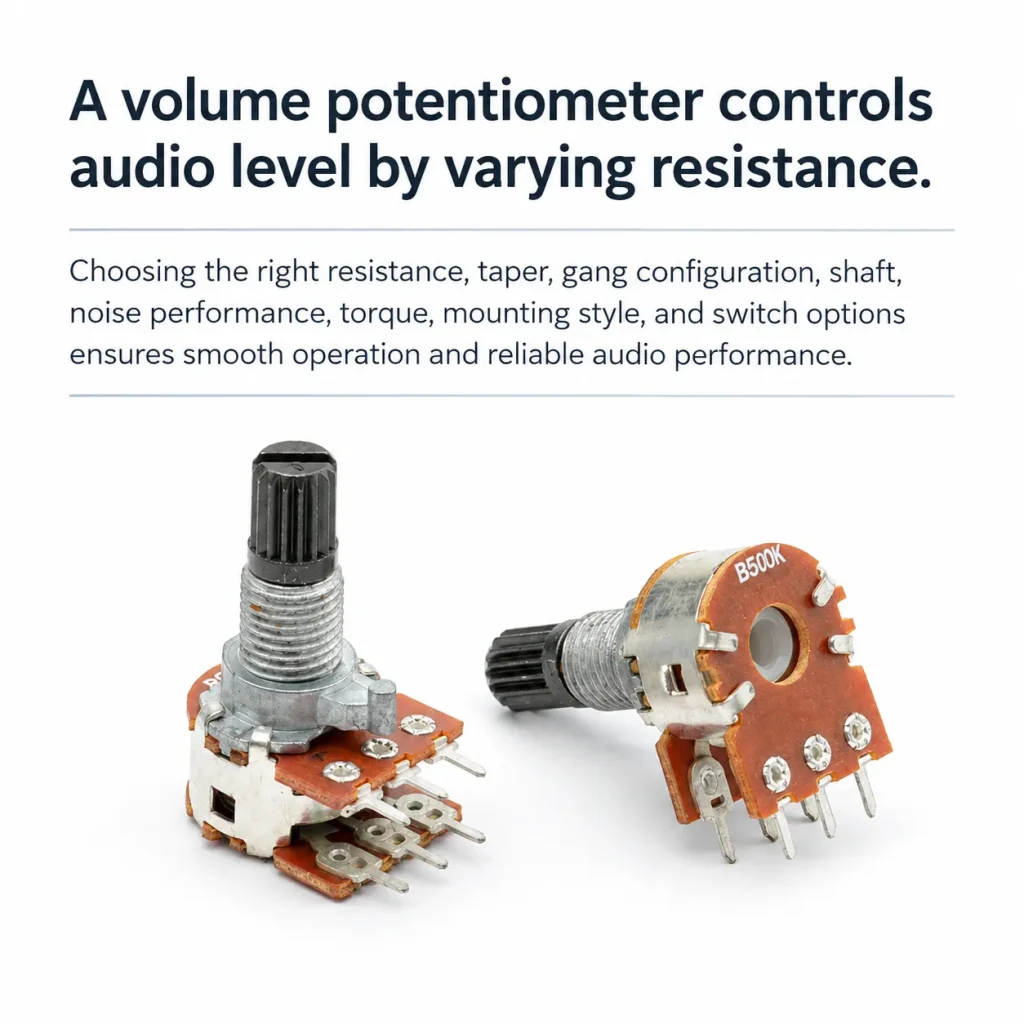
A volume potentiometer is a variable resistor commonly used to control the level of an audio signal.
When the shaft rotates, the wiper moves along the resistive track. This changes the electrical output sent to the next stage of the audio circuit.
A typical audio control may use:
Audio input → Volume potentiometer → Amplifier circuit → Speaker
Unlike a simple on/off control, the volume control provides continuously adjustable signal attenuation.
For stereo equipment, a dual-gang design can control the left and right channels with one shaft.
The most important parameters include:
- Resistance value
- Resistance taper
- Number of gangs
- Shaft dimensions
- Mounting method
- Rotational angle
- Torque
- Mechanical life
- Noise performance
- Switch configuration
2. Choose the Right Resistance Value
Resistance value is one of the first specifications to check.
Common values for audio applications include:
- 10KΩ
- 20KΩ
- 50KΩ
- 100KΩ
- 250KΩ
- 500KΩ
- 1MΩ
However, there is no single resistance value that is suitable for every audio circuit.
The value should be selected according to the circuit design, source impedance, input impedance, signal level, and requirements of the following amplifier stage.
A higher resistance can reduce the load on the previous circuit, but it may also make the control more sensitive to environmental interference and circuit noise.
A lower resistance can place a greater load on the signal source.
Therefore, engineers should follow the circuit designer’s requirements instead of choosing a resistance value simply because it is commonly used.
3. Linear vs Audio Taper
For volume control, taper is especially important.
Linear Taper
With a linear taper, the resistance changes approximately proportionally with the shaft position.
For example, the electrical ratio may be approximately:
0% rotation → 0%
50% rotation → 50%
100% rotation → 100%
Linear taper can be useful for applications where a proportional electrical change is required.
However, human hearing does not perceive loudness linearly.
Audio Taper
Audio taper, often called logarithmic taper, is commonly used for volume controls.
The resistance changes according to a logarithmic characteristic, which better matches the way people perceive changes in sound level.
As a result, rotating the knob can produce a more natural volume adjustment.
For audio equipment, the taper should therefore be checked carefully before selecting a component.
A potentiometer with the correct resistance but the wrong taper may still work electrically, but the user experience can be very different.
4. Single-Gang vs Dual-Gang
The number of gangs depends on the number of audio channels that need to be controlled.
Single-Gang
A single-gang potentiometer controls one signal channel.
It is suitable for:
- Mono amplifiers
- Single-channel equipment
- Simple audio circuits
- Certain industrial control systems
Dual-Gang
A dual-gang potentiometer contains two resistive sections controlled by the same shaft.
This allows one knob to control two channels simultaneously.
It is commonly considered for:
- Stereo amplifiers
- Headphone amplifiers
- Powered speakers
- Audio mixers
- Stereo receivers
- Car audio equipment
For stereo applications, channel tracking is also important. The resistance characteristics of the two sections should remain sufficiently close throughout the operating range.
5. Check the Shaft and Mounting Dimensions
Electrical specifications are only part of the selection process.
The potentiometer must physically fit the equipment.
Important mechanical parameters include:
Shaft Diameter
Common shaft designs include different diameters depending on the knob and panel structure.
Shaft Length
The shaft must extend far enough through the panel to properly connect with the knob.
A shaft that is too short or too long can create assembly problems.
Shaft Shape
Common options include:
- Round shaft
- D-shaped shaft
- Knurled shaft
- Slotted shaft
The shaft shape must match the knob.
Bushing
The bushing can affect panel mounting and mechanical stability.
Threaded bushings are commonly used when the potentiometer needs to be secured directly to a panel.
Mounting Type
The component may use:
- PCB mounting
- Panel mounting
- Horizontal PCB mounting
- Vertical PCB mounting
Before ordering, compare the manufacturer’s mechanical drawing with the PCB footprint and panel dimensions.
6. Consider Switch Options
Some volume controls include an integrated switch.
A switched volume potentiometer can combine:
Volume adjustment + ON/OFF control
This configuration can be useful for audio amplifiers, radios, speakers, and other equipment where panel space is limited.
For example, the user may rotate the knob to adjust volume and reach the end position to activate the power switch.
When selecting this type, check the switch configuration and electrical rating separately from the potentiometer specifications.
Important switch parameters include:
- Switch type
- Number of poles
- Number of positions
- Rated voltage
- Rated current
- Switching mechanism
- Terminal arrangement
7. Check Noise and Operating Feel
For audio applications, electrical noise and mechanical feel are important.
Contact Noise
Movement of the wiper across the resistive track can produce electrical fluctuations.
For audio equipment, a stable resistive element and suitable contact structure can help achieve smoother operation.
Carbon film technology is widely used in traditional audio controls because of its cost and practical performance.
Torque
Torque determines how much force the user needs to rotate the knob.
If the torque is too low, the knob may feel loose.
If it is too high, adjustment may feel uncomfortable.
The appropriate torque depends on the knob size, panel design, and expected user experience.
Rotational Angle
Many rotary controls use a rotation range around 270° to 300°, depending on the design.
The required angle should match the equipment’s control interface and circuit requirements.
8. How to Choose a Volume Potentiometer for Different Applications
Audio Amplifiers
For an amplifier, consider:
- Audio taper
- Appropriate resistance value
- Low operating noise
- Single or dual gang
- Suitable shaft
- Appropriate torque
A dual-gang audio taper design may be considered for stereo amplifiers.
Powered Speakers
Powered speakers often require compact components with stable mechanical performance.
The potentiometer should match the enclosure, PCB layout, and front-panel design.
Audio Mixers
Mixers may use both rotary controls and slide potentiometers.
A rotary volume control can be suitable for compact channel controls, while slide potentiometers provide visible linear positioning.
Guitar and Musical Equipment
For guitar and other musical equipment, resistance value, taper, shaft dimensions, mounting style, and physical compatibility with the control cavity should be checked carefully.
The correct replacement should match the original component’s electrical and mechanical specifications.
Automotive Audio
Automotive applications can require additional mechanical durability and stable operation over changing environmental conditions.
Shaft strength, mounting structure, operating temperature, and mechanical life should be considered during component selection.
9. OEM Customization
Standard volume potentiometers may not always match an existing product design.
For OEM and ODM projects, manufacturers may customize:
- Resistance value
- Taper
- Shaft length
- Shaft diameter
- Shaft shape
- Bushing
- Mounting structure
- Terminal position
- Torque
- Rotational angle
- Number of gangs
- Switch configuration
- Packaging
For example, a product may require a dual-gang 100KΩ audio taper potentiometer with a specific shaft length, PCB footprint, and integrated switch.
Providing the original sample, mechanical drawing, or PCB footprint can make the matching process more accurate.
10. Final Selection Checklist
Before purchasing a volume potentiometer, check the following specifications:
| Parameter | What to Check |
|---|---|
| Resistance | 10KΩ, 50KΩ, 100KΩ, etc. |
| Taper | Linear or audio/logarithmic |
| Gang | Single, dual, or multiple |
| Shaft | Diameter, length, shape |
| Bushing | Threaded or non-threaded |
| Mounting | PCB or panel |
| Rotation | Required operating angle |
| Torque | Required operating feel |
| Switch | With or without switch |
| Switch rating | Voltage and current |
| Life | Required operating cycles |
| Noise | Suitable for the audio circuit |
| Temperature | Required operating range |
Checking all of these parameters is safer than selecting a component based only on resistance.
11. Conclusion
Choosing a volume potentiometer requires both electrical and mechanical considerations.
For audio applications, the most important factors are usually resistance value, audio or linear taper, gang configuration, noise performance, shaft dimensions, mounting structure, and operating feel.
For stereo equipment, a dual-gang design can allow two channels to be controlled with one shaft. For compact equipment, a switched potentiometer can combine volume adjustment with power switching.
For OEM projects, customization may be necessary when the standard component does not match the PCB, panel, shaft, or circuit requirements.
The right volume potentiometer is not simply the one with the correct resistance. It is the one that matches the complete electrical, mechanical, and user-interface requirements of the product.