
October 29, 2026
News Brief
As electronic products become more compact and functional, engineers continue to evaluate how users interact with physical controls. Touchscreens and digital interfaces have expanded across consumer and industrial products, but potentiometers remain useful in applications that require continuous adjustment, direct physical feedback, and straightforward circuit integration. Selecting the right component still requires careful consideration of electrical performance, mechanical design, and operating conditions.
Physical Controls Remain Relevant in Modern Electronics
Electronic control systems have changed significantly over the past decade. Touchscreens, embedded software, and digital interfaces now play a major role in consumer electronics, industrial equipment, and automotive applications.
However, physical controls have not disappeared. Volume knobs, adjustment sliders, speed controls, and panel-mounted selectors remain common because they allow users to make immediate adjustments without navigating menus.
The potentiometer is one of the components supporting these functions. It provides a variable resistance that can be used to adjust voltage or control an electrical signal, depending on the circuit design.
Although its operating principle is relatively simple, the component must meet specific electrical and mechanical requirements to perform reliably throughout the product’s service life.
Why Potentiometers Continue to Be Used
One reason potentiometers remain relevant is their direct relationship between physical movement and electrical output.
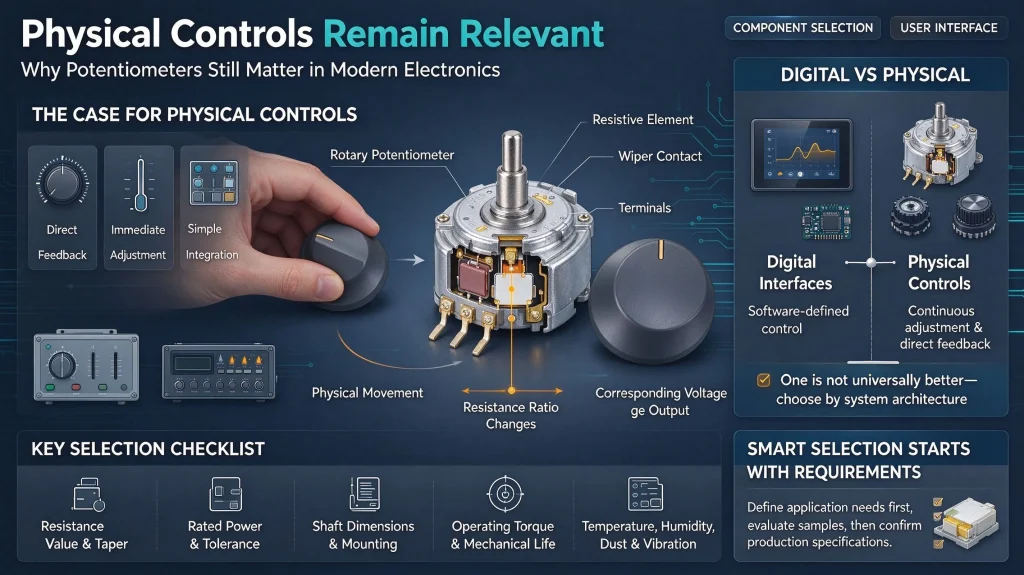
When a user rotates a shaft or moves a slider, the internal contact mechanism changes position along a resistive element. This movement changes the resistance ratio and, in a suitable circuit, produces a corresponding change in output voltage.
This operating principle makes potentiometers suitable for audio volume adjustment, lighting controls, industrial instruments, and other applications that require continuous manual adjustment.
A rotary potentiometer may be suitable for a compact control panel where users adjust a setting by turning a knob. A slide potentiometer can be more practical when the position of a control needs to be visible at a glance, such as on an audio mixing console.
The choice depends on the intended function, available installation space, and the required user experience.
Electrical Performance Is Only Part of the Selection Process
Resistance value is one of the first specifications engineers need to confirm. The selected value must match the circuit requirements and the intended operating range.
The resistance taper is also important. Linear and logarithmic tapers produce different relationships between shaft movement and electrical output. Audio volume controls, for example, often use a logarithmic taper to provide a more suitable perceived change in loudness.
Other electrical considerations include rated power, allowable resistance tolerance, contact resistance, and insulation performance. The importance of each parameter depends on the application.
Engineers should also consider the expected operating environment. Temperature variation, humidity, dust, and vibration can affect long-term performance if the component is not designed for the conditions in which it will be used.
A component that performs well on a laboratory bench may not necessarily provide the same results after repeated operation in an industrial environment.
Mechanical Design Influences Long-Term Reliability
The mechanical structure deserves equal attention.
Shaft length, shaft diameter, mounting dimensions, terminal layout, and rotational torque all influence whether a potentiometer fits the intended product. If these details are overlooked during the design stage, the component may require additional mechanical work or PCB changes.
Operating life is another important consideration. Repeated movement places demands on the resistive element, contact system, shaft, and supporting structure. Buyers should review the manufacturer’s specified mechanical life and electrical performance requirements rather than assuming that all components with the same resistance value are interchangeable.
Dust protection may also matter in applications where the control is exposed to airborne particles. Sealed or dust-resistant designs can help address particular environmental requirements, although the actual protection level must be confirmed from the product specification.
For equipment manufacturers, these details affect more than component selection. They can influence assembly efficiency, maintenance requirements, and the consistency of the finished product.
Customization Helps Address Product Design Constraints
Standard components are often sufficient for common applications. However, some projects require dimensions or operating characteristics that are not available in an existing catalogue.
Examples include a shorter shaft for a compact enclosure, a different resistance value for a revised circuit, a particular terminal arrangement, or a dual-gang structure for controlling two signal channels.
In these situations, working directly with a component manufacturer can help engineers assess whether a customized design is practical.
Shenzhen Sanhezheng Electronics Co., Ltd., operating under the Sunhorizon name, supplies potentiometers, slide potentiometers, rotary encoders, and rotary switches. Its published product information includes customization options for resistance, shaft dimensions, component size, and terminal structure.
For OEM and ODM projects, the useful starting point is a clear technical specification. Buyers should provide drawings, electrical requirements, installation constraints, and expected operating conditions before requesting a quotation or prototype.
Samples should then be evaluated in the intended circuit and mechanical assembly before volume production begins.
Potentiometers and Digital Controls Can Serve Different Needs
The growth of digital interfaces does not mean every physical adjustment should be replaced with software.
A potentiometer may be appropriate when continuous resistance adjustment is required. A rotary encoder may be more suitable when the system needs digital input, incremental position information, or software-defined control.
Some products use both technologies. A physical knob may provide the familiar user interface, while an encoder sends signals to a microcontroller that manages the selected function.
The decision should be based on system architecture rather than on the assumption that one component is universally better than another.
What Buyers Should Check Before Ordering
Before selecting a potentiometer for production, purchasing teams and engineers should confirm several points:
- Electrical specifications, including resistance value, taper, tolerance, and rated power.
- Mechanical dimensions, shaft design, mounting method, and terminal configuration.
- Required operating torque and expected mechanical life.
- Environmental conditions, including temperature, humidity, dust, and vibration.
- Sample availability, production consistency, quality documentation, and delivery requirements.
These checks help reduce compatibility problems and avoid unnecessary redesign work.
Conclusion
Potentiometers continue to serve an important role in electronic products that require direct, continuous adjustment. Their long-term usefulness depends not simply on their operating principle, but on how well the electrical characteristics, mechanical structure, and environmental requirements match the final application.
For engineers developing audio equipment, industrial controls, household appliances, or automotive electronics, careful component selection remains an essential part of product development. Manufacturers such as Sunhorizon can be considered when standard specifications need to be reviewed or customized to fit a particular design.
The most effective approach is to define the application requirements first, evaluate samples against those requirements, and confirm production specifications before placing a volume order.