
Table of Contents
- Why Volume Potentiometers Matter in Audio Equipment
- How to Choose the Right Volume Potentiometer
- Audio Taper and Resistance Selection
- Single-Gang and Dual-Gang Volume Controls
- Custom Volume Potentiometer Specifications
- Comparison of Volume Control Options
- OEM Customization for Amplifier and Speaker Manufacturers
- Conclusion
Why Volume Potentiometers Matter in Audio Equipment
A volume potentiometer plays an important role in amplifiers, speakers, mixers, and other audio equipment. It allows users to adjust sound levels through a rotating knob. The right component helps provide smooth adjustment, a suitable operating feel, and reliable performance.
For audio manufacturers, a standard control may not meet every design requirement. A product may need a special shaft length, a specific resistance value, a compact housing, or a dual-channel structure. A custom volume potentiometer helps engineers match the control to the circuit and enclosure.
The main goal is simple: provide convenient volume adjustment without compromising circuit performance or product design.
Before choosing a component, engineers should consider resistance, taper, channel configuration, mounting style, operating torque, and mechanical life. These factors affect both the control experience and the compatibility of the finished product.
How to Choose the Right Volume Potentiometer
The first step is to understand how the volume control works in the target circuit.
A typical analog volume control uses a resistive track and a moving contact called a wiper. When the user turns the shaft, the wiper changes the signal level delivered to the next circuit stage.
For an amplifier, the control often adjusts a low-level audio signal before amplification. Some designs use a different circuit arrangement, so engineers should confirm the required function before selecting the component.
Key selection factors include:
- Resistance value: Match the circuit design and input requirements.
- Taper: Choose a suitable relationship between shaft position and signal level.
- Channel count: Select a single-gang or dual-gang structure as required.
- Shaft design: Check length, diameter, shape, and knob compatibility.
- Mounting style: Confirm panel mounting or PCB installation.
- Operating torque: Choose a suitable turning feel for the product.
- Electrical noise: Evaluate contact noise and signal stability.
- Mechanical life: Confirm the required operating cycles.
A volume potentiometer should match the electrical circuit and mechanical assembly. Selecting by price or resistance alone may lead to compatibility problems during product development.
Audio Taper and Resistance Selection
Resistance and taper are two essential specifications for a volume potentiometer.
Common resistance values include 10KΩ, 20KΩ, 50KΩ, and 100KΩ. Other values may suit specific audio circuits. The correct choice depends on source impedance, input impedance, circuit topology, and the required control range.
The taper determines how the signal changes as the shaft rotates.
An audio or logarithmic taper often suits volume adjustment because human hearing perceives changes in sound level nonlinearly. It can provide more useful adjustment across the knob’s rotation than a linear taper in many audio applications.
A linear taper may still suit particular circuits or control functions. Engineers should check the circuit requirements and test the actual response before confirming a production specification.
When requesting a custom volume potentiometer, buyers should provide the nominal resistance, tolerance, taper, rated power, and terminal arrangement. This information helps the supplier evaluate the correct component.
Single-Gang and Dual-Gang Volume Controls
The number of resistive sections depends on the audio system.
A single-gang volume potentiometer contains one resistive section. It can suit mono audio equipment or a circuit that requires one adjustable signal path.
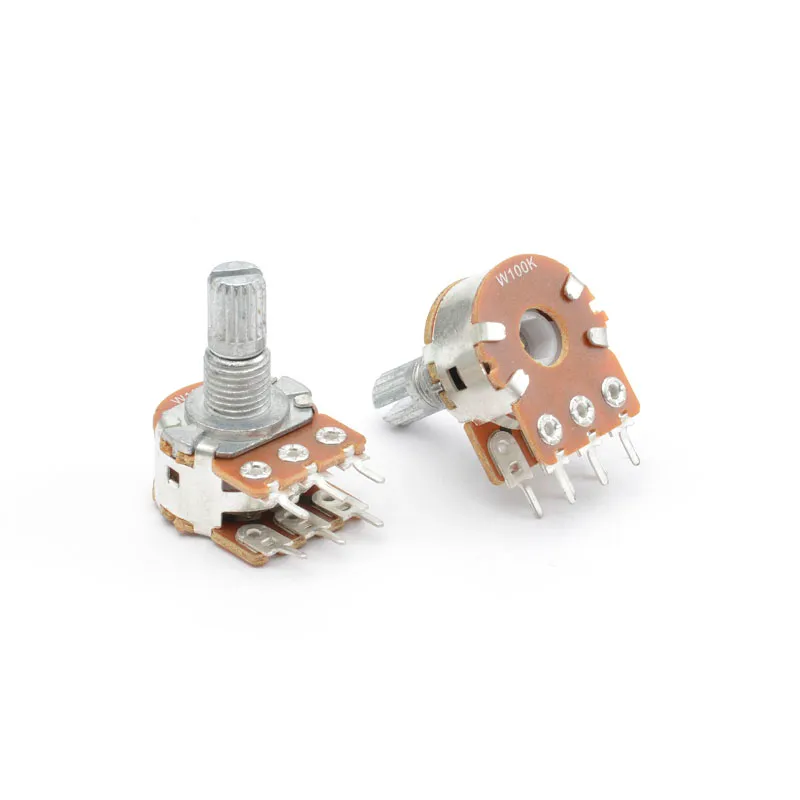
A dual-gang volume potentiometer contains two sections operated by one shaft. It is commonly used for stereo volume control because one knob adjusts the left and right channels together.
Channel tracking matters in stereo systems. If the two sections produce different attenuation at the same shaft position, the perceived balance between the speakers may change, especially at low volume.
Engineers should therefore evaluate channel tracking across the useful adjustment range. They should also confirm the required resistance taper and mechanical dimensions.
For compact audio equipment, a small dual-gang rotary control may reduce installation space. The final choice depends on PCB layout, enclosure dimensions, and the required electrical performance.
Custom Volume Potentiometer Specifications
Customisation helps manufacturers match the control to their product design. Depending on the selected model and factory capabilities, possible options include:
- Resistance value and taper
- Shaft length, diameter, and shape
- Metal or insulated plastic shaft
- Threaded bushing dimensions
- Horizontal or vertical PCB mounting
- Single-gang or dual-gang construction
- Operating torque
- Terminal layout
- Optional switch configuration
Shaft dimensions deserve special attention. If the shaft does not match the front panel or knob, the assembly may require costly changes. The same applies to mounting dimensions and PCB pin positions.
For replacement projects, engineers should share the original part number, drawings, samples, or PCB footprint. For new designs, a mechanical drawing and electrical specification provide a useful starting point.
Suppliers can then review the requirements and confirm which options are feasible for sampling and mass production.
Comparison of Volume Control Options
| Feature | Standard Volume Control | Custom Volume Potentiometer |
|---|---|---|
| Resistance | Standard available values | Selected for project requirements |
| Taper | Standard options | Specified for the intended response |
| Shaft | Standard dimensions | Custom dimensions where supported |
| Channel design | Common configurations | Matched to circuit requirements |
| Mounting | Existing footprints | Layout reviewed for compatibility |
| Operating torque | Standard range | Target range subject to confirmation |
| Application fit | General-purpose designs | Tailored to the equipment design |
A custom component does not automatically offer better performance. Its value lies in matching the application’s electrical and mechanical requirements. Samples and application testing remain important before bulk production.
OEM Customization for Amplifier and Speaker Manufacturers
Amplifier and speaker manufacturers often need controls that fit a specific enclosure, PCB, and user interface. A component supplier with OEM support can review these details early in development.
For example, a stereo amplifier may require a dual-gang volume potentiometer with an audio taper and a shaft designed for a particular front panel. A compact speaker may need a small rotary control with horizontal PCB terminals.
Sunhorizon manufactures rotary controls for electronic equipment applications. Buyers can review the RD092N-HA1-41C-F 9mm sealed rotary potentiometer for compact control applications and the RA111G-H 11mm dual-unit rotary potentiometer for dual-channel designs.
These products can serve as starting points for discussing the required configuration. Buyers should confirm the exact resistance, taper, shaft dimensions, mounting structure, and other specifications with the supplier before placing an order.
To speed up the quotation process, provide the target application, technical drawing, annual demand, expected order quantity, and sample requirements. This allows the factory to assess the project more accurately.
Technical References for Volume Control Design
Texas Instruments discusses the behavior of logarithmic volume controls in its technical article, Logarithmic Potentiometers. This reference helps explain why taper selection affects perceived volume adjustment.
For an alternative approach, Analog Devices provides an audio amplifier reference design that demonstrates electronic volume control in an audio circuit.
These references show that engineers should choose a control method based on the circuit architecture. A mechanical volume potentiometer and an electronic volume-control IC may offer different design advantages. The best solution depends on the product’s performance targets, cost, interface, and system requirements.
Conclusion
Choosing the right volume potentiometer helps amplifier and speaker manufacturers achieve suitable sound-level adjustment, a consistent operating feel, and reliable integration.
Resistance, audio taper, channel tracking, shaft dimensions, mounting style, and mechanical life all deserve attention during component selection. Custom options can help address special requirements that standard parts cannot meet.
Before mass production, confirm the electrical and mechanical specifications, evaluate samples in the actual circuit, and check compatibility with the enclosure and PCB.
For OEM projects, early communication with the component supplier can reduce design changes and help establish a more reliable production plan.